
Introduction to Supervised vs. Unsupervised Machine Learning
How AI Actually Learns From Data
Machine Learning (ML) has transformed how we analyze data, build intelligent systems, and make predictions across industries, from healthcare and finance to cybersecurity and marketing. At its core, ML enables computers to learn patterns from data and make decisions without being explicitly programmed.
Among the various types of machine learning, two of the most fundamental paradigms are Supervised Learning and Unsupervised Learning. Understanding their differences, use cases, and algorithms is key to mastering the foundations of data science and AI.
What is Machine Learning?
Machine Learning is a subfield of Artificial Intelligence (AI) that focuses on developing algorithms capable of learning from data and improving over time without human intervention.
Instead of following static instructions, an ML model identifies patterns and relationships within datasets, enabling it to make predictions or decisions.
Depending on the nature of the data and the problem being solved, ML tasks can generally be categorized into three main types:
- Supervised Learning
- Unsupervised Learning
- Reinforcement Learning
In this article, we’ll focus on the first two that is; Supervised vs. Unsupervised Learning to understand how they differ in approach, data requirements, and applications.
Supervised Learning
Definition
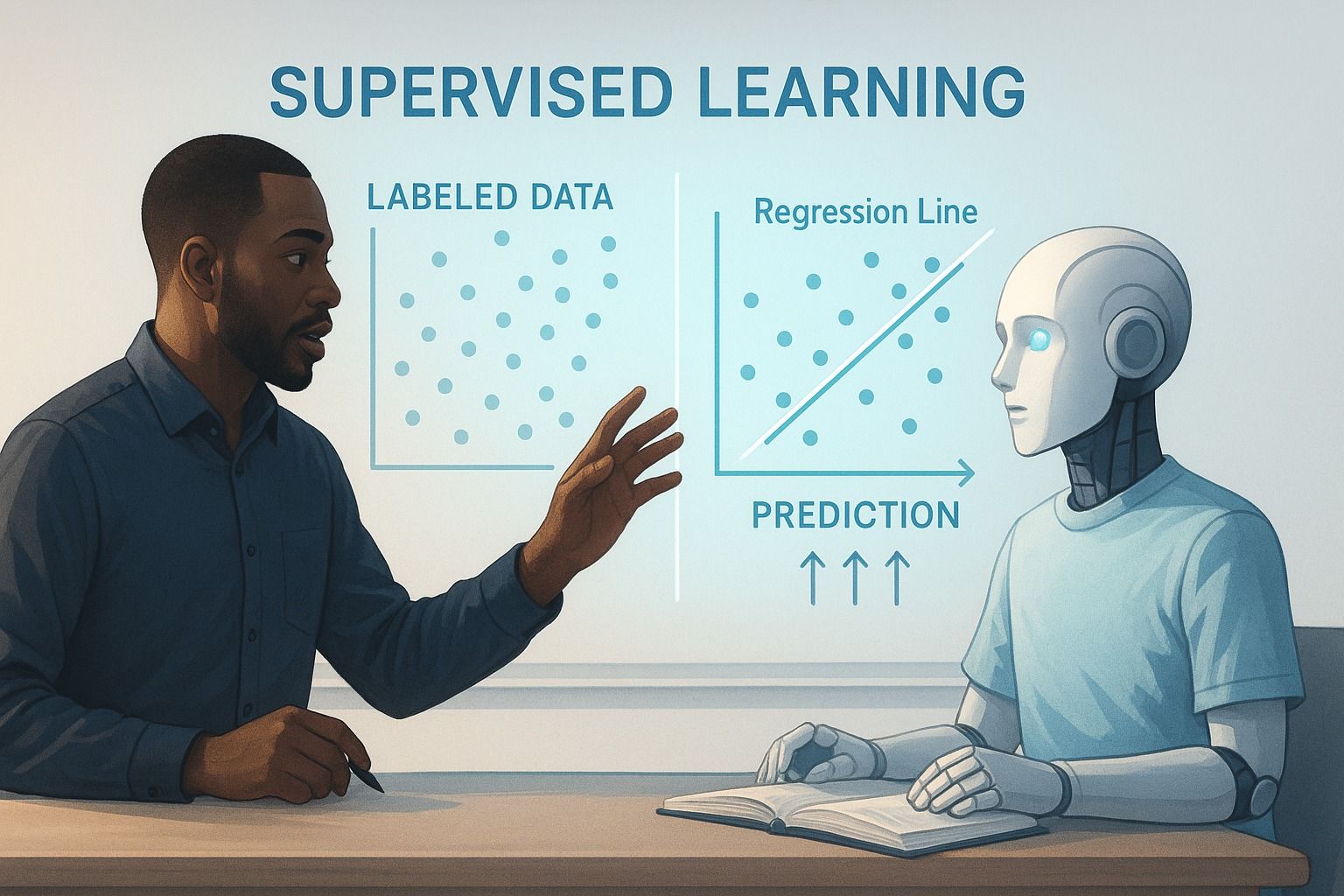
Supervised Learning involves training a model on a labeled dataset, meaning each input data point is paired with the correct output. The algorithm learns by comparing its predicted outputs with the actual outcomes and adjusting accordingly to minimize errors.
Essentially, it’s like learning under the supervision of a “teacher,” where the correct answers are known in advance.
How It Works
1. Training Phase:
The model is fed with a labeled dataset containing input-output pairs (X, Y).
Example:
- Input (X): House size, number of bedrooms, location
- Output (Y): House price
2. Model Learning:
The algorithm finds relationships between the features (X) and the target variable (Y).
3. Prediction Phase:
When given new, unseen data, the model predicts the output based on what it learned during training.
Common Algorithms
- Linear Regression: Predicts continuous outcomes (e.g., price prediction).
- Logistic Regression: Used for binary classification (e.g., spam or not spam).
- Decision Trees and Random Forests: Used for both classification and regression.
- Support Vector Machines (SVM): Classifies data by finding optimal hyperplanes.
- Neural Networks: Used for complex problems like image or speech recognition.
Applications
- Healthcare: Predicting disease risk from patient data.
- Finance: Credit scoring and fraud detection.
- Marketing: Customer churn prediction and demand forecasting.
- Cybersecurity: Email phishing detection and intrusion detection.
Advantages
- High accuracy when labeled data is available
- Easy to evaluate model performance using metrics (e.g., accuracy, precision, recall)
- Suitable for both regression and classification tasks
Limitations
- Requires large amounts of labeled data (which can be expensive and time-consuming)
- May not generalize well to unseen or unbalanced data
Unsupervised Learning
Definition
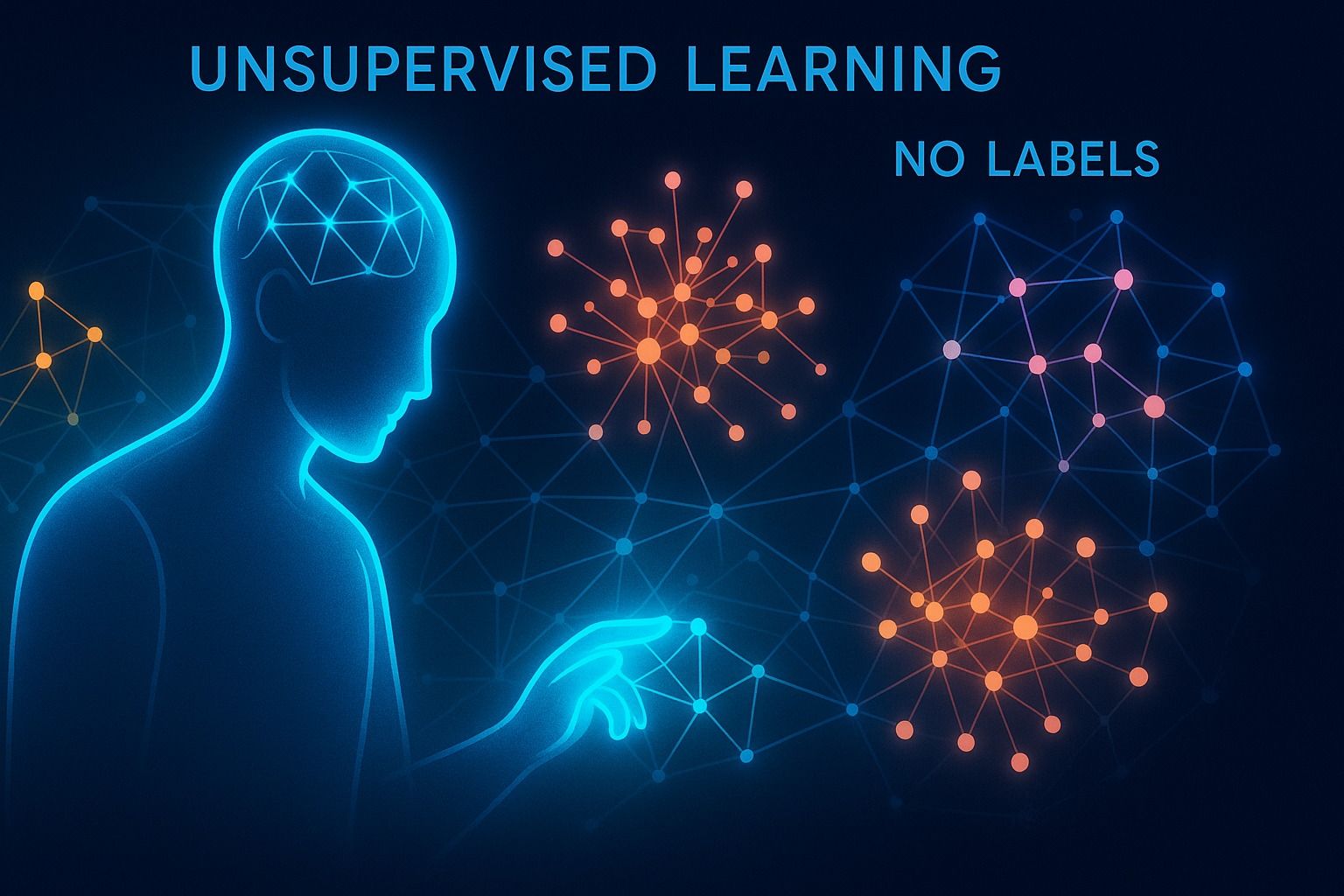
Unsupervised Learning deals with unlabeled data, where the algorithm tries to discover hidden structures, patterns, or relationships without predefined outputs.
Unlike supervised learning, there is no “teacher” or known answer thus the model learns by itself.
How It Works
- Input: The dataset contains only input features (X) with no output labels.
- Model Training: The algorithm analyzes similarities and differences between data points.
- Output: The model groups, organizes, or reduces the data based on identified patterns.
Common Algorithms
- K-Means Clustering: Groups similar data points into k clusters.
- Hierarchical Clustering: Builds nested clusters based on data hierarchy.
- Principal Component Analysis (PCA): Reduces dimensionality while preserving important information.
- DBSCAN: Detects clusters of varying shapes and noise in data.
- Autoencoders: Neural network-based models for representation learning or anomaly detection.
Applications
- Customer Segmentation: Grouping users by purchasing behavior.
- Anomaly Detection: Identifying unusual activity in networks or transactions.
- Topic Modeling: Discovering topics in text datasets.
- Data Compression: Reducing dataset size for efficient computation.
- Medical Research: Grouping patients with similar symptoms or genetic profiles.
Advantages
- Works without labeled data
- Can uncover hidden patterns and insights not obvious to humans
- Useful for exploratory data analysis and feature engineering
Limitations
- Difficult to evaluate accuracy (no ground truth)
- Results can be ambiguous or sensitive to parameter selection
- May require domain knowledge to interpret findings
When to Use Which?
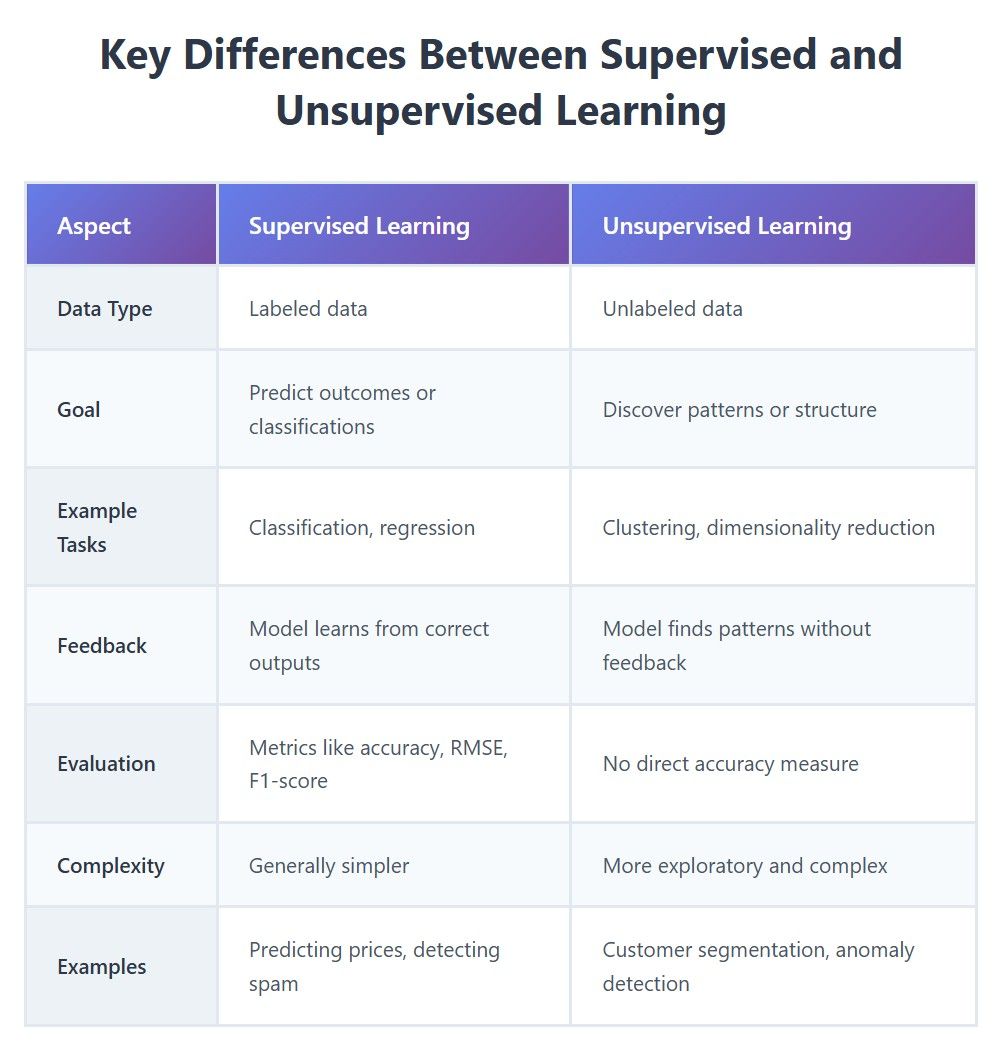
Choosing between supervised and unsupervised learning depends on your data type and business goal:
1. Use Supervised Learning when:
- You have labeled data.
- The goal is prediction or classification.
- You want measurable performance (e.g., accuracy).
2. Use Unsupervised Learning when:
- You have unlabeled data.
- You want to explore or discover hidden patterns.
- You need data grouping or anomaly detection.

Real-World Example
Supervised Example – Email Spam Detection
A dataset contains thousands of emails labeled as spam or not spam.
A supervised model (e.g., logistic regression or Naïve Bayes) learns from these examples to predict whether a new incoming email is spam.
Unsupervised Example – Customer Segmentation
An e-commerce platform wants to understand its customers without prior knowledge.
By applying K-Means Clustering, customers are grouped based on purchase frequency, amount spent, and product categories hence allowing personalized marketing strategies.
Final Thoughts
Supervised and Unsupervised Learning are the two pillars of machine learning — one focuses on prediction, while the other emphasizes discovery.
In practice, both approaches complement each other. For instance, unsupervised clustering can be used to create labels for a supervised classification model.
As the world generates more data than ever, mastering both paradigms is essential for any data scientist or AI engineer seeking to build intelligent, data-driven systems.
Additional Resources
“Pattern Recognition and Machine Learning” by Christopher M. Bishop
“Hands-On Machine Learning with Scikit-Learn, Keras & TensorFlow” by Aurélien Géron
Scikit-Learn Documentation: https://scikit-learn.org/
Get Sasa by email
Generative AI, Africa now. One edition, no more than once a week.