
Loss Functions and Optimizers Explained
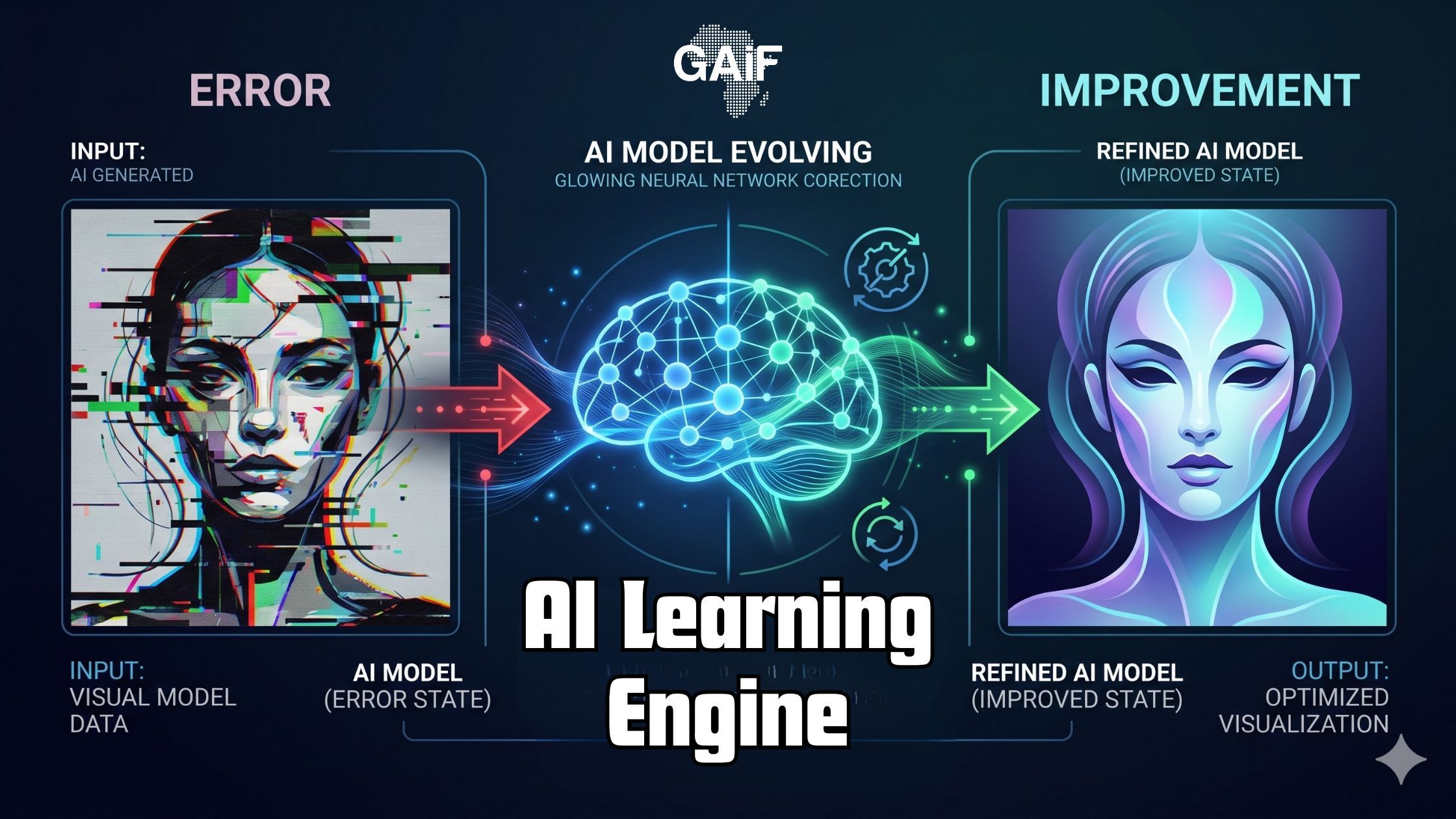
Fixing prediction errors
Introduction
In machine learning and deep learning, training a model involves two essential components: loss functions and optimizers.
- A loss function measures how well a model is performing.
- An optimizer adjusts the model to improve its performance.
Together, they form the core of how neural networks learn from data.
What Is a Loss Function?
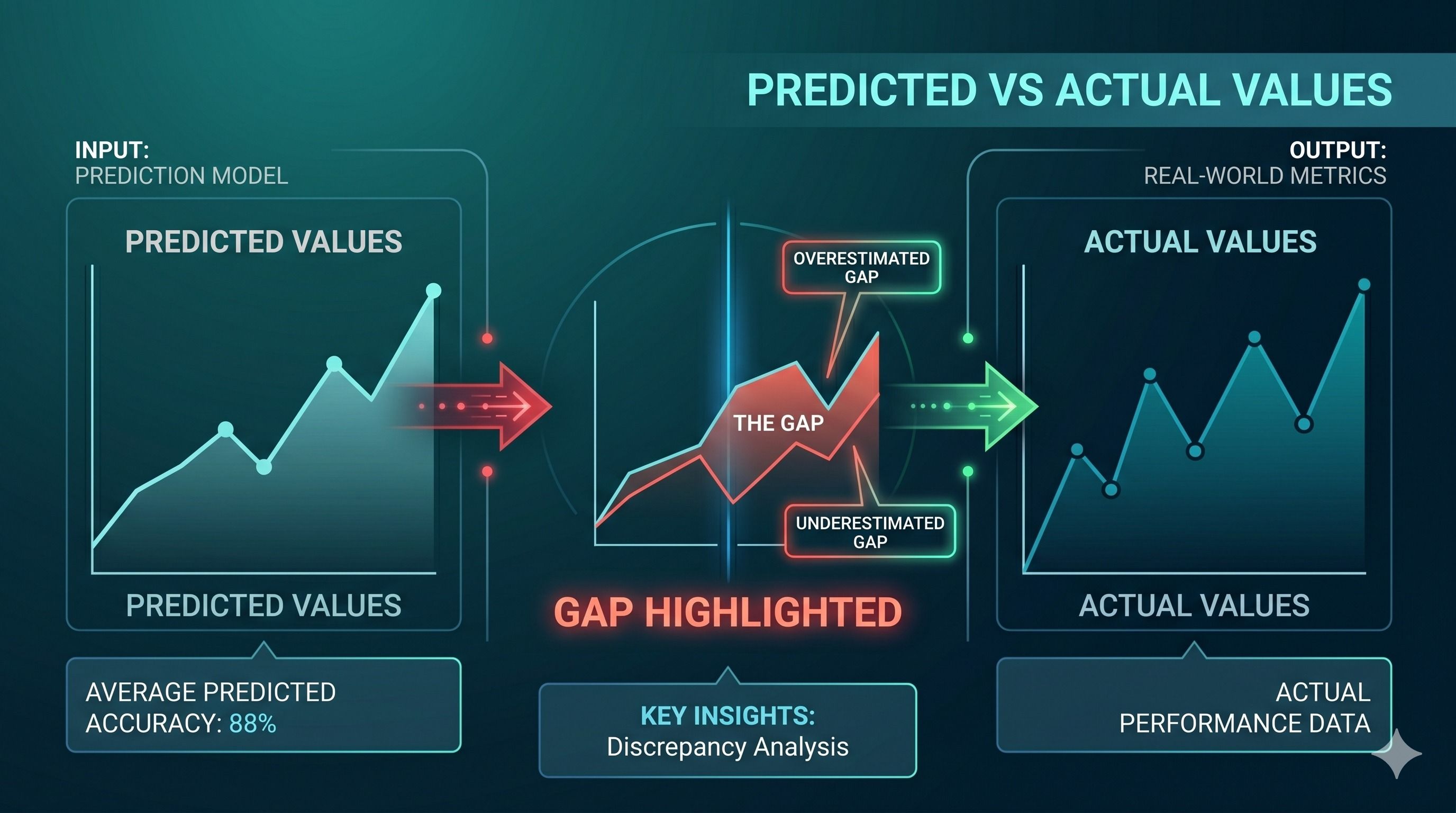
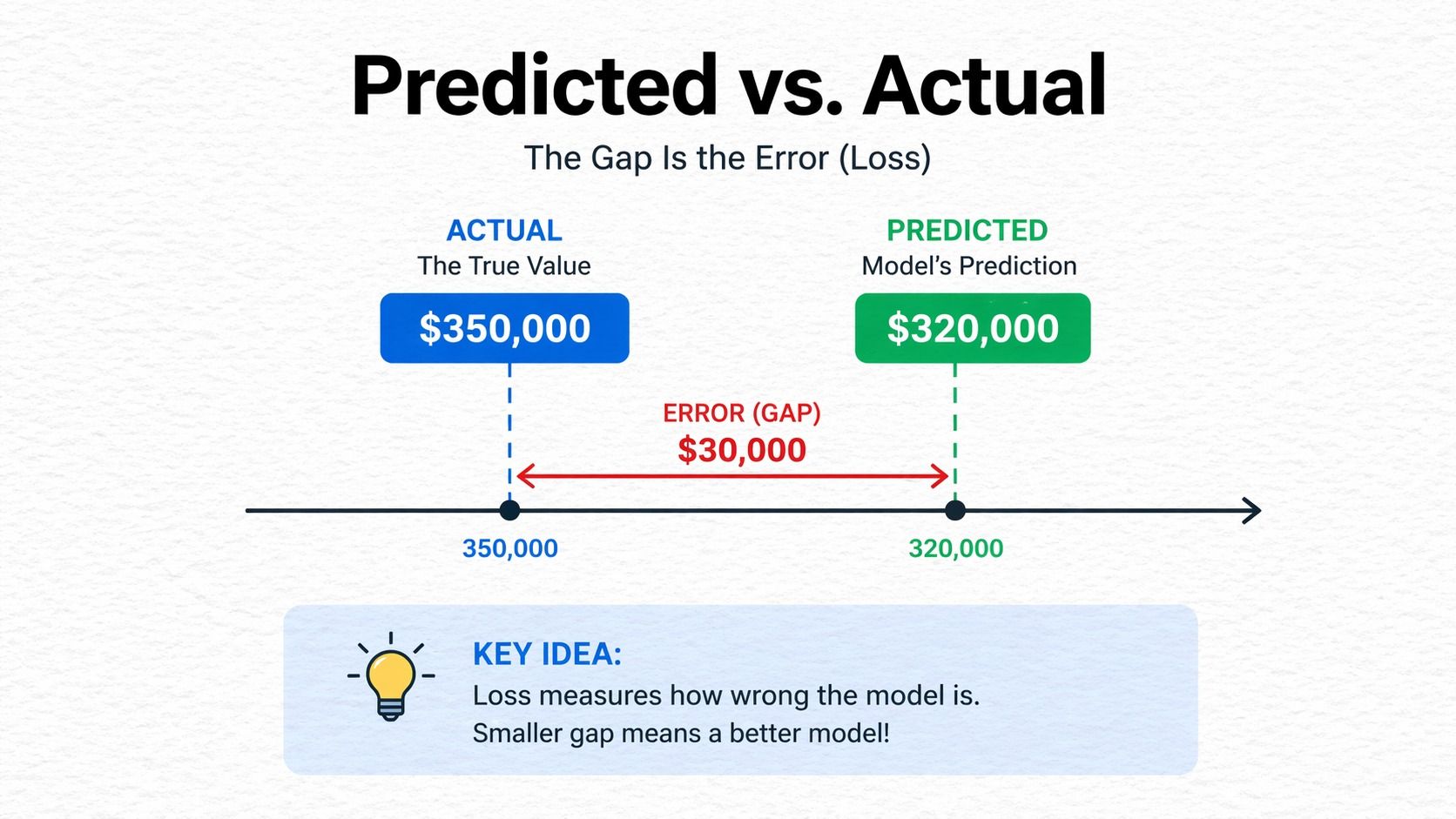
A loss function is a mathematical function that calculates the difference between the model’s predicted output and the actual target value.
In simple terms, it answers the question:
“How wrong is the model?”
The goal during training is to minimize the loss.
Types of Loss Functions
1. Mean Squared Error (MSE)
Used in regression problems.
Formula:
MSE = (1/n) Σ(actual − predicted)²
Key Idea:
Penalizes larger errors more heavily.
Use Case:
- House price prediction
- Temperature forecasting
2. Mean Absolute Error (MAE)
Also used in regression tasks.
Key Idea:
Measures the average absolute difference between predictions and actual values.
Use Case:
- When you want less sensitivity to outliers
3. Binary Cross-Entropy
Used for binary classification problems.
Key Idea:
Measures how well the model predicts probabilities for two classes.
Use Case:
- Spam detection
- Disease prediction (yes/no)
4. Categorical Cross-Entropy
Used for multi-class classification.
Key Idea:
Evaluates how close predicted probabilities are to the actual class.
Use Case:
- Image classification
- Digit recognition
What Is an Optimizer?
An optimizer is an algorithm used to adjust the model’s parameters (weights and biases) to minimize the loss function.
It answers the question:
“How can we reduce the error?”
How Optimizers Work
Optimizers use a technique called gradient descent:
- Calculate the loss
- Compute gradients (direction of error)
- Update weights to reduce the loss
- Repeat until the model improves
Common Optimizers
1. Gradient Descent
The most basic optimization algorithm.
Types:
- Batch Gradient Descent
- Stochastic Gradient Descent (SGD)
- Mini-batch Gradient Descent
Limitation:
Can be slow and may get stuck in local minima.
2. Stochastic Gradient Descent (SGD)
Updates weights using one data point at a time.
Advantages:
- Faster updates
- Works well for large datasets
Limitation:
- Can be noisy and unstable
3. Adam (Adaptive Moment Estimation)
One of the most popular optimizers in deep learning.
Key Features:
- Combines momentum and adaptive learning rates
- Efficient and widely used
Use Case:
- Most deep learning models
Relationship Between Loss Functions and Optimizers
Loss functions and optimizers work together:
- The loss function tells the model how wrong it is
- The optimizer updates the model to reduce that error
This cycle continues during training:
Prediction → Loss Calculation → Optimization → Improved Prediction
Example Workflow
- Input data is passed into the model
- The model makes a prediction
- The loss function calculates the error
- The optimizer updates the model weights
- The process repeats over many iterations
Choosing the Right Combination
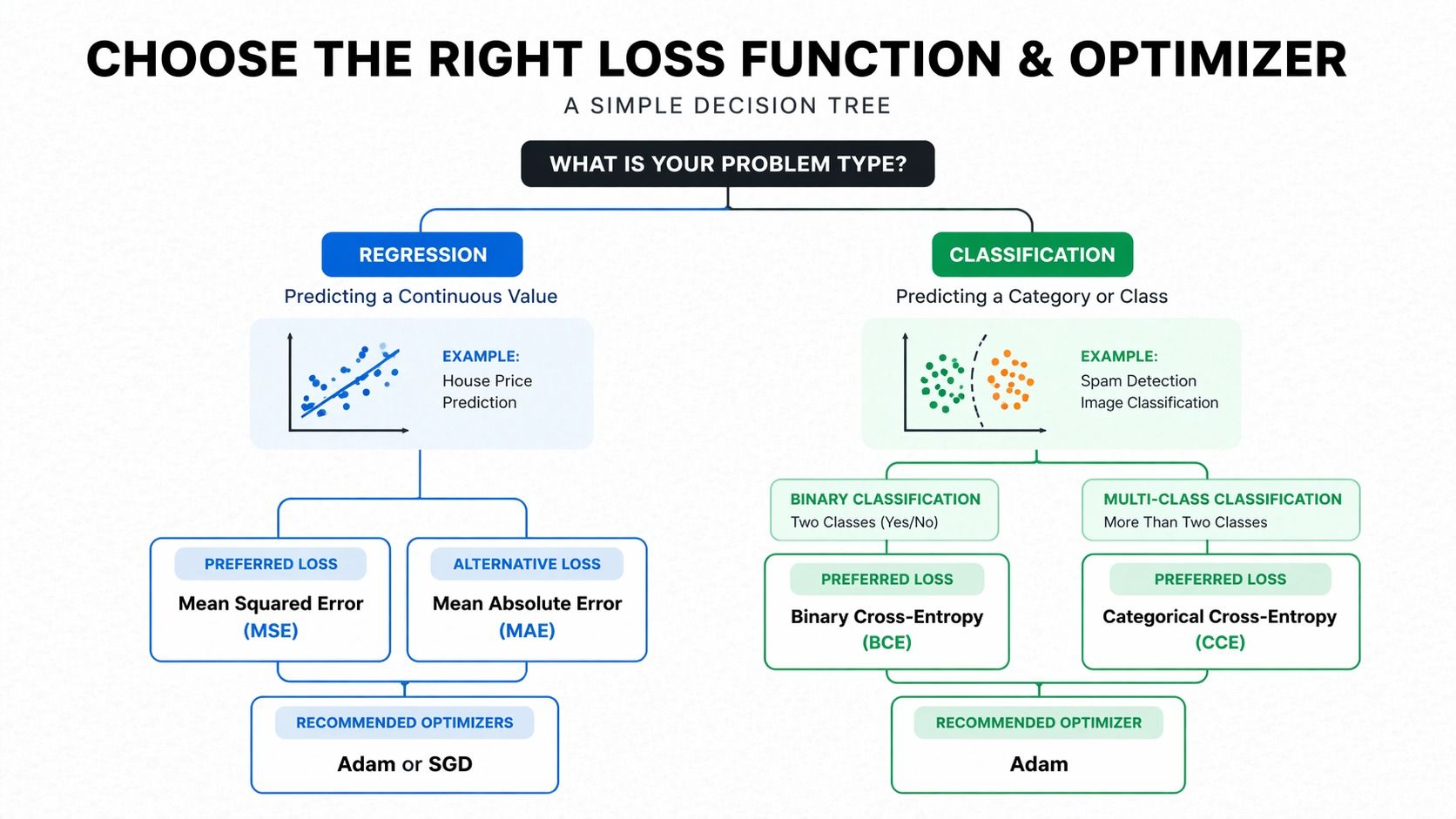
- Regression problems → MSE or MAE + Adam/SGD
- Binary classification → Binary Cross-Entropy + Adam
- Multi-class classification → Categorical Cross-Entropy + Adam
The right combination improves both accuracy and training speed.
Advantages
- Enables models to learn from mistakes
- Improves prediction accuracy over time
- Works across different types of problems
Limitations
- Poor choice of loss function can lead to incorrect learning
- Optimizers may converge slowly or get stuck
- Requires tuning of parameters like learning rate
Conclusion
Loss functions and optimizers are fundamental to how machine learning models learn. The loss function measures how far the model is from the correct answer, while the optimizer adjusts the model to improve its performance.
Understanding how these two components work together is essential for building effective and accurate AI systems.
Get Sasa by email
Generative AI, Africa now. One edition, no more than once a week.