
Python Libraries Every Data Scientist Must Know
Python’s must-have data tools

Python has become the lingua franca of data science, largely due to its rich ecosystem of specialized libraries. Whether you're cleaning data, building models, or creating visualizations, there's a Python library designed to make your work more efficient. This guide explores the essential libraries that every data scientist should have in their toolkit.
Data Manipulation and Analysis
NumPy: The Foundation of Numerical Computing
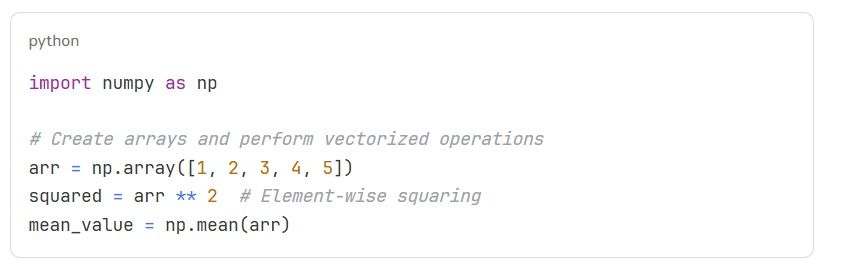
NumPy (Numerical Python) is the cornerstone of scientific computing in Python. It provides support for large, multi-dimensional arrays and matrices, along with a collection of mathematical functions to operate on these arrays efficiently.
Key Features:
- N-dimensional array objects with broadcasting capabilities
- Vectorized operations that eliminate the need for explicit loops
- Linear algebra, Fourier transform, and random number generation
- Integration with C/C++ and Fortran code
When to Use: NumPy is essential for any numerical computation, serving as the foundation for most other data science libraries. Use it when you need fast array operations, mathematical functions, or when working with numerical data at scale.
Pandas: Data Manipulation Made Easy
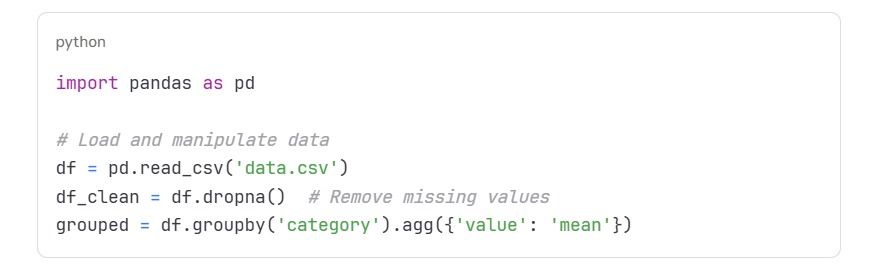
Pandas is the go-to library for data manipulation and analysis. It introduces two powerful data structures: Series (1-dimensional) and DataFrame (2-dimensional), which make working with structured data intuitive and efficient.
Key Features:
- DataFrames for handling tabular data
- Robust data cleaning capabilities (handling missing data, filtering, merging)
- Time series functionality
- SQL-like operations (groupby, join, merge)
- Easy data import/export (CSV, Excel, SQL, JSON)
When to Use: Pandas is your primary tool for data preprocessing, exploratory data analysis, and data wrangling. It excels at cleaning messy datasets and transforming data into the right format for analysis.
Visualization Libraries
Matplotlib: The Plotting Powerhouse
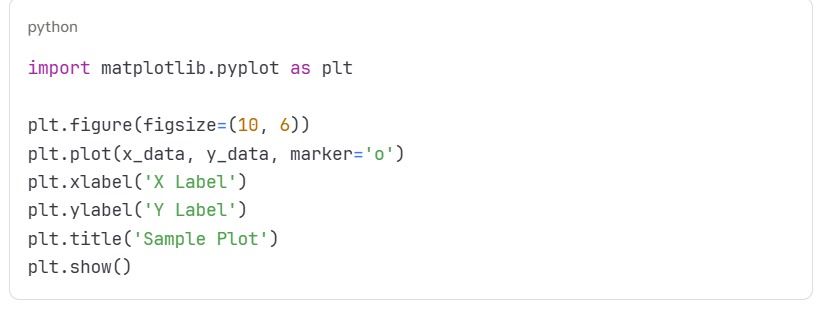
Matplotlib is the foundational plotting library in Python, offering fine-grained control over every aspect of your visualizations. While it has a steeper learning curve, it provides unmatched flexibility.
Key Features:
- Comprehensive range of plot types (line, scatter, bar, histogram, etc.)
- Publication-quality figures
- Fine control over plot elements (axes, labels, colors, styles)
- Integration with NumPy and Pandas
When to Use: Use Matplotlib when you need precise control over your visualizations or when creating plots for academic papers and presentations.
Seaborn: Statistical Visualization Simplified
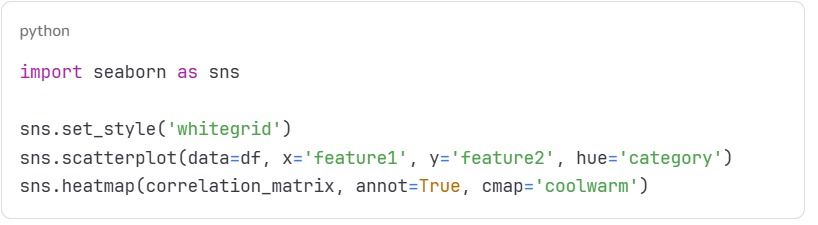
Built on top of Matplotlib, Seaborn provides a high-level interface for creating attractive statistical graphics with minimal code. It comes with several built-in themes and color palettes.
Key Features:
- Beautiful default styles and color palettes
- Built-in functions for complex statistical plots
- Seamless integration with Pandas DataFrames
- Automatic estimation and plotting of statistical relationships
When to Use: Choose Seaborn for exploratory data analysis when you want to quickly create informative statistical visualizations without extensive customization.
Machine Learning Libraries
Scikit-learn: Machine Learning Made Accessible
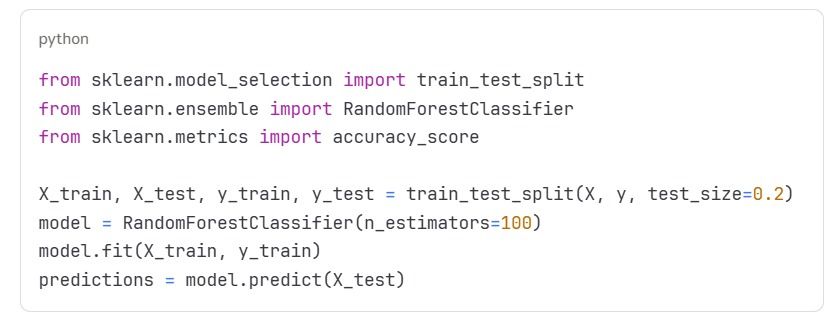
Scikit-learn is the most popular machine learning library in Python, offering a consistent interface for a wide range of supervised and unsupervised learning algorithms.
Key Features:
- Comprehensive collection of ML algorithms (classification, regression, clustering)
- Model selection and evaluation tools
- Data preprocessing and feature engineering utilities
- Pipeline construction for streamlined workflows
- Excellent documentation and community support
When to Use: Scikit-learn is your first choice for traditional machine learning tasks. It's perfect for prototyping models, comparing algorithms, and building production-ready ML systems.
TensorFlow and PyTorch: Deep Learning Frameworks
For deep learning projects, TensorFlow and PyTorch are the two dominant frameworks. TensorFlow, developed by Google, offers robust production deployment capabilities, while PyTorch, from Meta, is favored for research due to its intuitive, Pythonic interface.
Key Features:
- Neural network construction and training
- GPU acceleration for faster computation
- Pre-trained models and transfer learning
- Support for various architectures (CNNs, RNNs, Transformers)
When to Use: Turn to these frameworks when working with deep learning tasks such as image recognition, natural language processing, or when you need to build custom neural network architectures.
Statistical Analysis
SciPy: Scientific Computing Tools
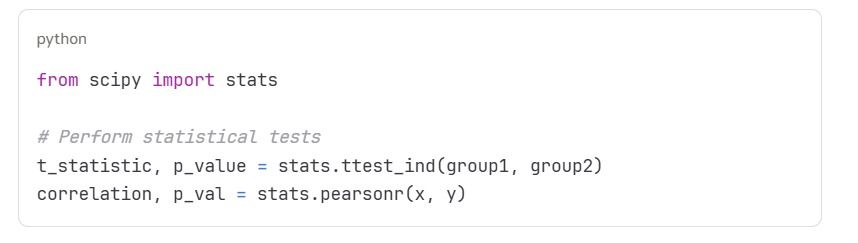
SciPy builds on NumPy by adding a collection of algorithms and functions for scientific and technical computing, including optimization, integration, interpolation, and statistical functions.
Key Features:
- Statistical distributions and tests
- Optimization and root-finding algorithms
- Signal and image processing
- Linear algebra operations beyond NumPy
- Integration and differential equation solvers
When to Use: SciPy is essential when you need advanced statistical tests, optimization algorithms, or scientific computations that go beyond basic NumPy functionality.
from scipy import stats
Statsmodels: Statistical Modeling
Statsmodels provides classes and functions for estimating statistical models, conducting statistical tests, and performing statistical data exploration with a focus on classical statistics.
Key Features:
- Linear regression models (OLS, WLS, GLS)
- Time series analysis (ARIMA, SARIMA)
- Hypothesis testing and statistical tests
- Detailed statistical summaries
When to Use: Choose Statsmodels when you need detailed statistical inference, hypothesis testing, or classical econometric models with comprehensive summary statistics.
Specialized Libraries
NLTK and spaCy: Natural Language Processing
For text analysis and NLP tasks, NLTK (Natural Language Toolkit) and spaCy are indispensable. NLTK is excellent for education and research, while spaCy is optimized for production use with pre-trained models.
When to Use: Use these libraries for tokenization, part-of-speech tagging, named entity recognition, sentiment analysis, and other text processing tasks.
XGBoost and LightGBM: Gradient Boosting Machines
These libraries implement gradient boosting algorithms that consistently achieve top performance in machine learning competitions. They're highly efficient and offer excellent predictive accuracy.
When to Use: Deploy these when you need state-of-the-art performance on structured/tabular data, especially in competitive scenarios or when accuracy is paramount.
Best Practices for Library Management
- Environment Management: Use virtual environments (venv, conda) to manage library dependencies and avoid version conflicts between projects.
- Stay Updated: Regularly update your libraries to benefit from bug fixes, performance improvements, and new features, but test thoroughly before updating production code.
- Read the Documentation: Each library has extensive documentation with tutorials and examples. Investing time in understanding core concepts pays dividends.
- Start Simple: Begin with high-level libraries like Pandas and Scikit-learn before diving into lower-level tools. Build complexity gradually as your needs grow.
Conclusion
Mastering these Python libraries will significantly accelerate your data science workflow. While this list covers the essentials, the Python ecosystem continues to evolve with new libraries emerging for specialized tasks. Start with the fundamentals like NumPy, Pandas, Matplotlib, and Scikit-learn then expand your toolkit based on your specific project requirements. The key is not just knowing these libraries exist, but understanding when and how to apply them effectively to solve real-world data problems.
Get Sasa by email
Generative AI, Africa now. One edition, no more than once a week.