
AI vs. ML vs. Deep Learning Explained
Clear guide to AI, Machine Learning, and Deep Learning
Introduction
Everywhere you look today, you’ll hear about Artificial Intelligence (AI), Machine Learning (ML), and Deep Learning (DL).
- Artificial Intelligence (AI) is in your phone’s voice assistant.
- Machine Learning (ML) is behind your email spam filter.
- Deep Learning (DL) powers self-driving cars and advanced chatbots.
These terms often get mixed up. In this article, we’ll break down AI, ML, and DL in simple language, compare them, and show real-world examples so you’ll never confuse them again.
What is Artificial Intelligence (AI)?
The term artificial intelligence was first used in 1956, at a computer science conference in Dartmouth. AI described an attempt to model how the human brain works and, based on this knowledge, create more advanced computers. The scientists expected that to understand how the human mind works and digitalize it shouldn’t take too long.
Artificial Intelligence is the broadest concept. It’s about creating systems that can mimic human intelligence, that is, thinking, reasoning, and problem-solving.
Example:
- Siri or Alexa understanding voice commands.
- Google Translate converting text between languages.
AI is like the umbrella field: inside it, we find Machine Learning and Deep Learning.
Types of AI:
Narrow/Weak AI → Specialized in one task (e.g., Deep Blue, AlphaGo). Widely used today in business, healthcare, and science.
General/Strong AI → Hypothetical AI that thinks, learns, and feels like humans. Still a work in progress.
Superintelligence → A futuristic concept where AI surpasses human intelligence in every domain. More science fiction than reality, for now.
What is Machine Learning (ML)?
Machine Learning is a subset of AI. Instead of being explicitly programmed, ML systems learn from data.
Example:
Netflix recommends movies based on what you’ve watched.
Banks detecting fraudulent credit card transactions.
Key Idea:
AI is the goal (“make machines smart”).
ML is one approach to reach that goal (“teach machines using data”).
Types of Machine Learning.
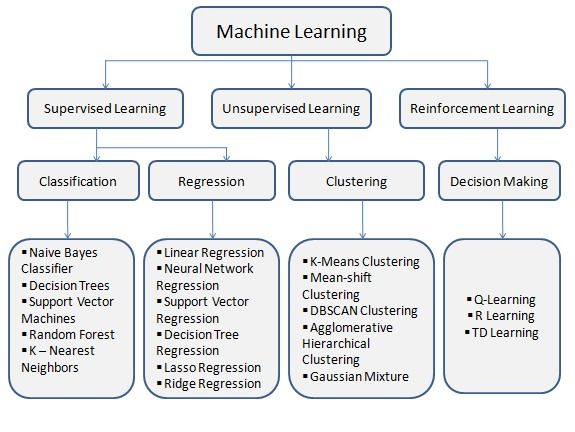
- Supervised Learning → Learns from labeled data (teacher-guided). Best for classification & regression (e.g., spam filtering, language detection).
- Unsupervised Learning → Works with unlabeled data, finds hidden patterns/clusters (e.g., anomaly detection, recommendations).
- Semi-supervised Learning → Mix of labeled & unlabeled data. Useful when labeling is costly but partial supervision is available.
- Reinforcement Learning → Learns by trial and error with reward signals. Great for games, robotics, and real-world decision-making.
In short, Supervised = “with answers”, Unsupervised = “no answers”, Semi = “some answers”, and Reinforcement = “learn by doing”.
What is Deep Learning (DL)?
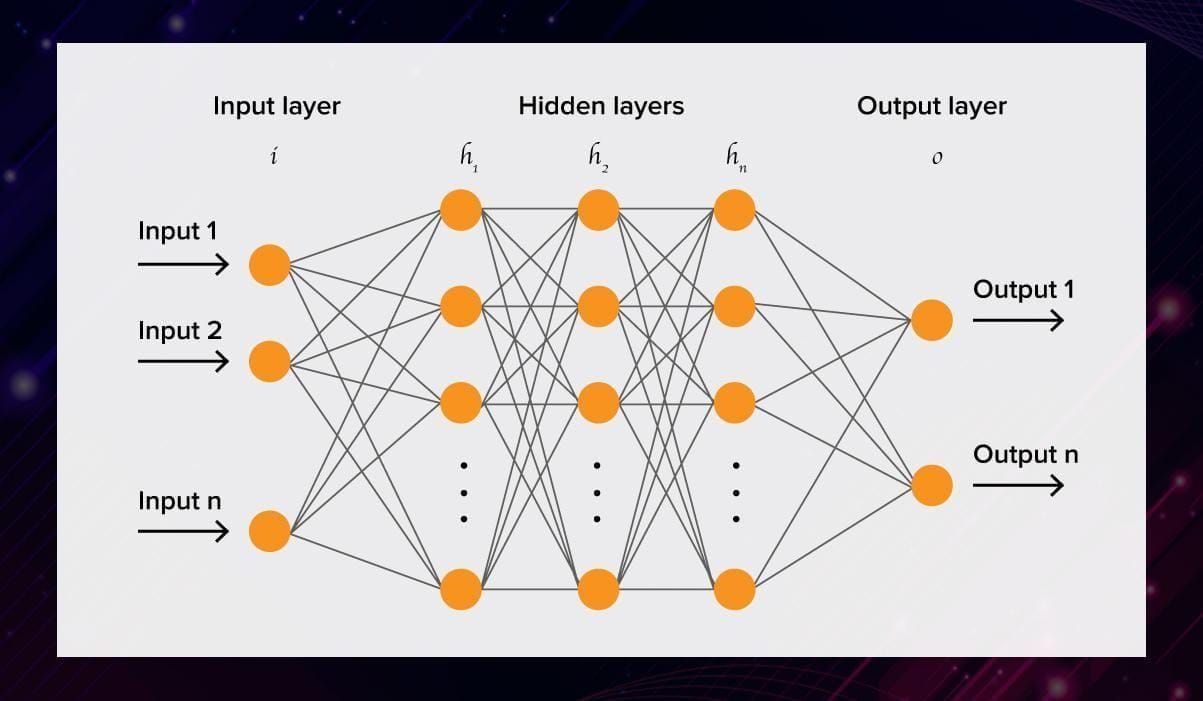
Deep Learning is a subset of Machine Learning. It uses artificial neural networks with many layers (hence “deep”) to learn from massive amounts of data.
Example:
- Self-driving cars detecting pedestrians and road signs.
- ChatGPT understanding and generating human-like text.
Deep Learning = ML on steroids, especially useful when dealing with images, speech, and text.
Hands-On Example: ML vs. DL
Let’s look at a quick Python example using the MNIST dataset (handwritten digits).
We will compare:
- A Machine Learning approach (Logistic Regression)
- A Deep Learning approach (Neural Network with Keras)
Example 1: Machine Learning (Logistic Regression))
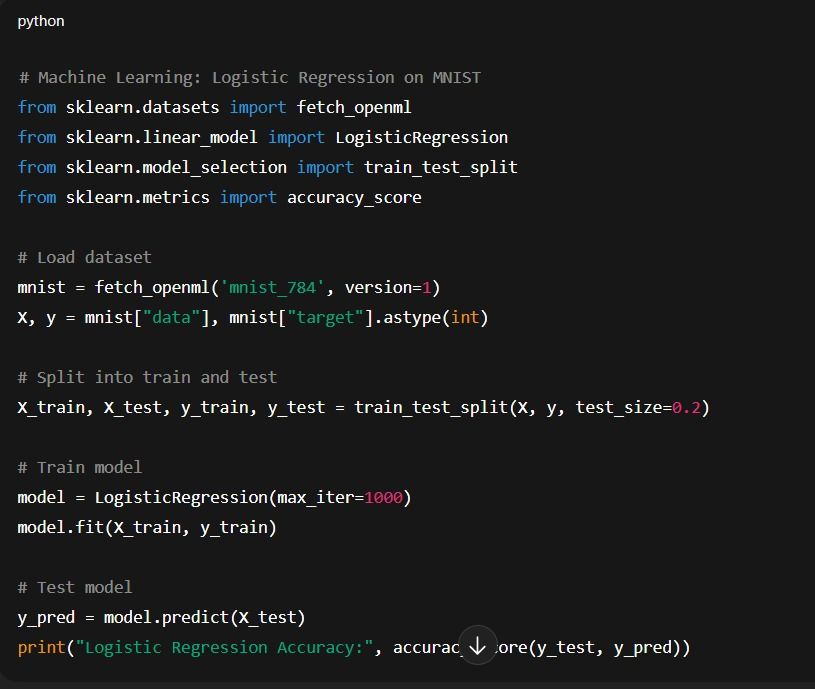
This is Machine Learning. It works with structured data and simple algorithms.
Example 2: Deep Learning (Neural Network)
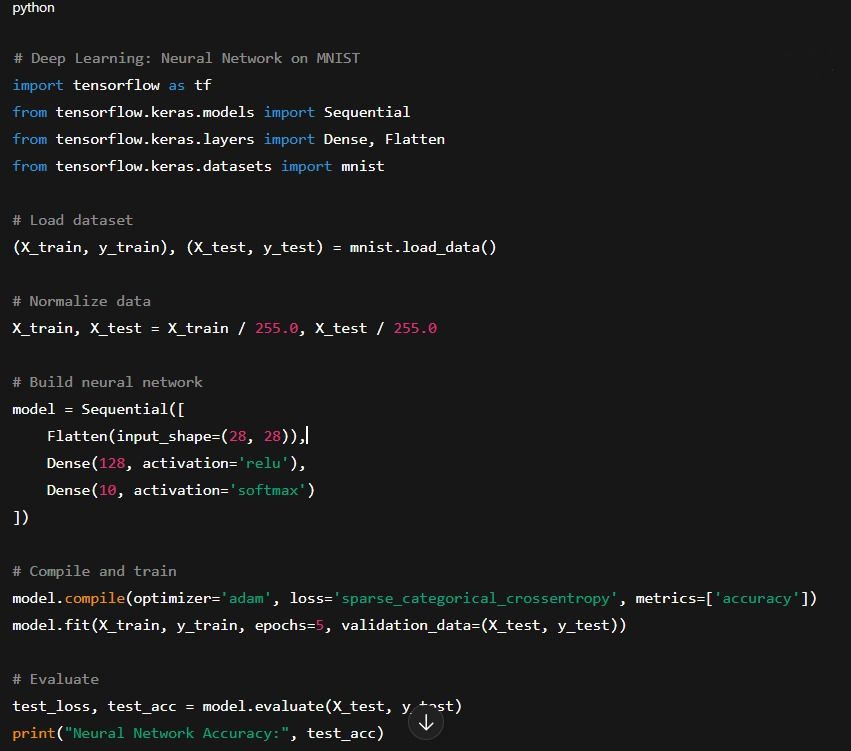
This is Deep Learning. It uses neural networks and can achieve much higher accuracy, especially with large datasets.
Key Takeaway from the Code
- Logistic Regression (ML) → Fast, simple, works well for smaller datasets.
- Neural Network (DL) → More complex, requires more data & computation, but achieves state-of-the-art performance.
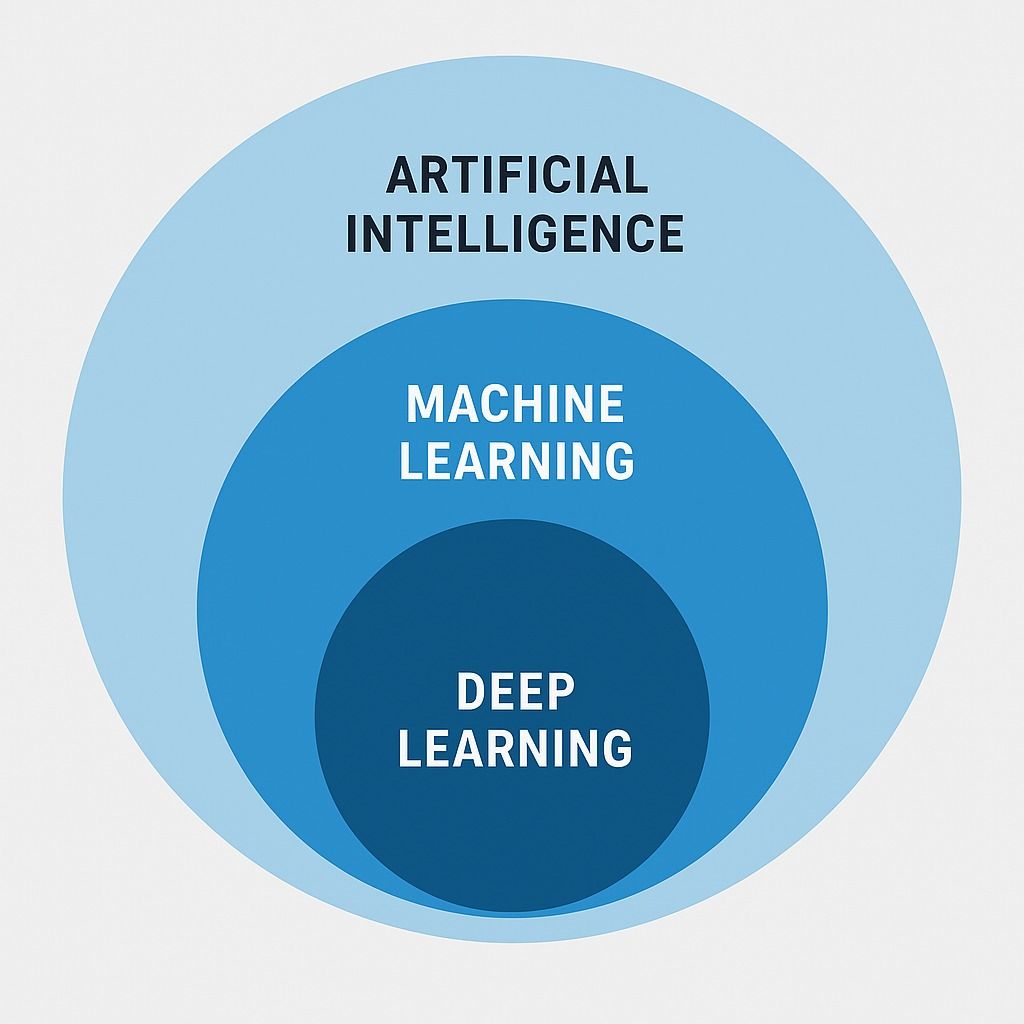
The Hierarchy (Visual Analogy)
Think of it like nested circles:
- AI → The big circle (the goal: intelligent machines).
- ML → A smaller circle inside AI (machines learning from data).
- DL → The smallest circle inside ML (neural networks powering modern AI).
How They Differ (Side-by-Side)
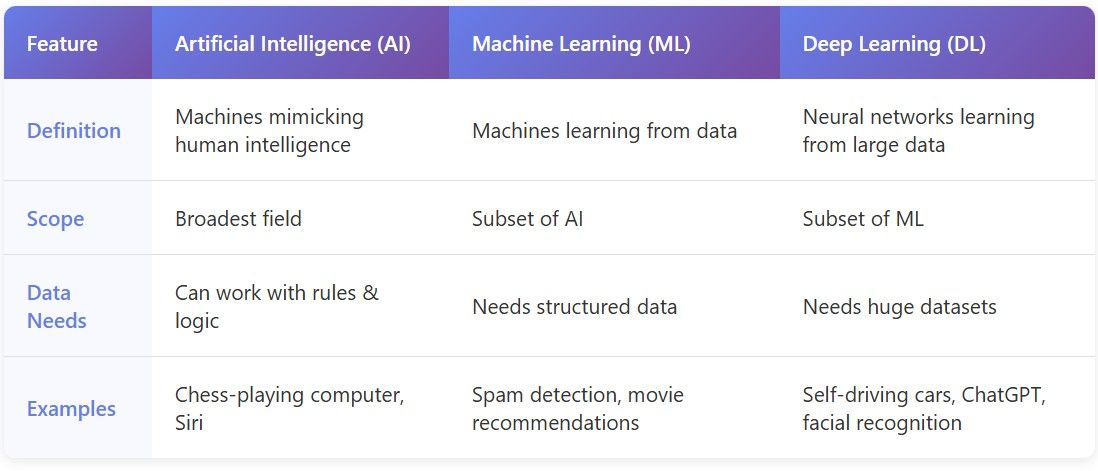
Real-World Examples
- AI: A chess program that plays strategically against humans.
- ML: Predicting house prices from historical sales data.
- DL: Google Photos automatically recognizing faces in your pictures.
Simple Analogy
Imagine teaching a child to recognize animals:
- AI: Tell the child, “This is a cat, this is a dog” (rules-based intelligence).
- ML: Give the child hundreds of pictures of cats and dogs until they learn to distinguish.
- DL: Give the child millions of pictures + advanced brain-like processing → they can now recognize cats, dogs, and even tigers they’ve never seen before.
Why Does This Matter?
Understanding the differences helps you know:
- Where each technology is applied.
- Why some companies prefer ML while others rely on DL.
- How you can plan your career path in AI/ML/DL depending on your interest.
Final Thoughts
- AI is the big idea: making machines “smart.”
- ML is one way to achieve AI: teaching machines with data.
- DL is the cutting edge of ML: using neural networks for complex tasks.
Today, almost every innovation from voice assistants to autonomous vehicles is powered by some combination of AI, ML, and DL.
So next time you hear these buzzwords, you’ll know exactly where they fit!
Get Sasa by email
Generative AI, Africa now. One edition, no more than once a week.